
Llandow Tuning technical analysis
A well-developed bootmod3 (BM3) off-the-shelf map can beat a weak generic file sold as a “custom tune”. That does not prove BM3 OTS maps generally outperform genuine vehicle-specific tuning.
BM3, APR and Revo can all deliver strong, refined gains. They are quality OTS products: reusable calibrations developed for a supported category. A completed custom tune is a measured development process carried out for the actual car. The two can be delivered through the same platform, but they are not the same service.
Connectivity, cloud map storage, flashing, logging, diagnostics, map editing and tuner collaboration.
A pre-developed stage, hardware and fuel variant intended for many compatible vehicles.
A file revised from measurements, logs and repeat tests on the particular vehicle and brief.
We are not arguing that BM3 is poor software, that every custom tuner is competent, or that custom tuning must always produce a bigger peak number. We are examining a specific sales claim, the evidence published with it, the loose use of the word custom, and what a persuasive OTS-versus-custom comparison would really require.
How BM3 tuning actually works
bootmod3 is best understood as a flashing, calibration-management, logging and diagnostics platform. It is not a separate engine computer and it is not one universal tune. ProTuningFreaks' current BM3 user manual and official FAQ show that the same ecosystem can deliver an OTS map, a custom map supplied through a tuner, or a multi-slot CustomROM calibration. Saying “BM3 versus custom tuning” can therefore be a category error: a genuine custom tuner can use BM3 as the delivery and logging platform.
Platform architecture / simplified
1. Connection, vehicle identity and unlocking
A phone or tablet can communicate through the BM3 Wi-Fi OBD adapter. A computer can use the supported cable and OBD Agent route. The app reads the vehicle identity and DME software so compatibility and unlock requirements can be checked. BM3 says many supported DMEs can be unlocked over OBD, while its February 2026 manual also lists bench and FEMTO routes for vehicles that require them. The exact path depends on the DME, software and vehicle; “plug in and flash” is not a universal description.
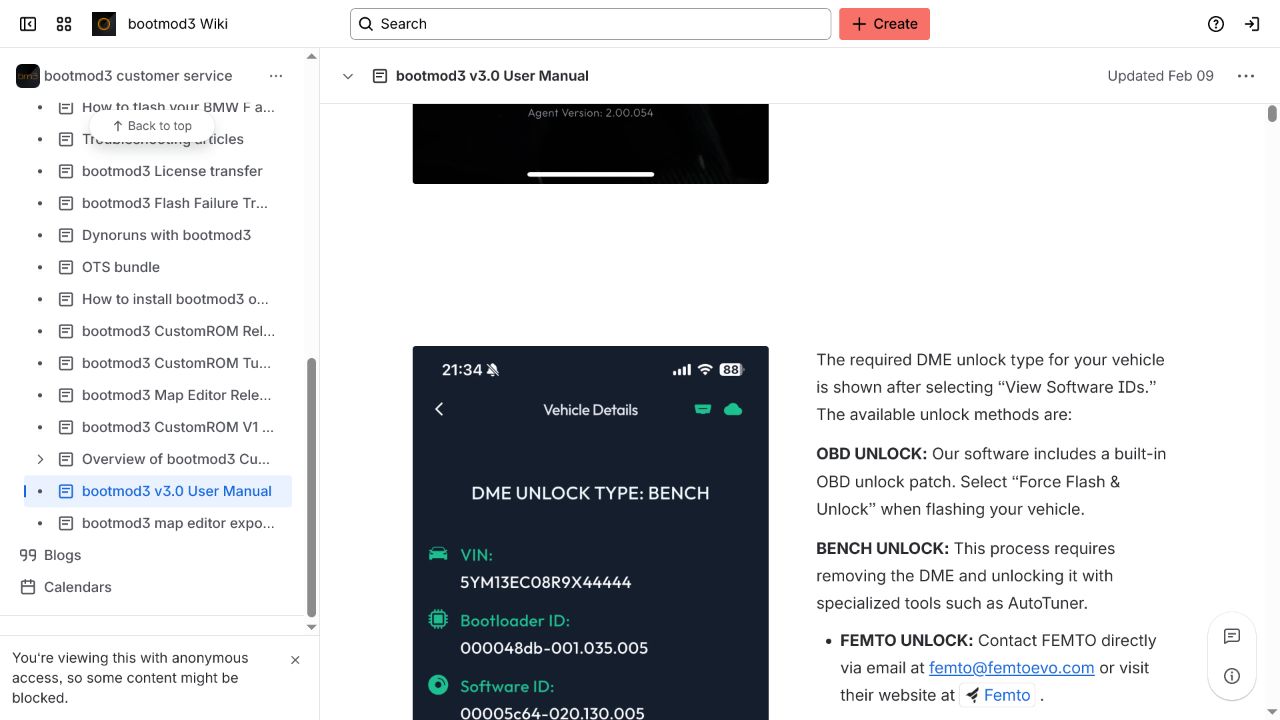
BM3 checks the vehicle's DME unlock type and documents more than one route.
It does not show that the calibration eventually flashed is optimal for the individual car.
Flashing also needs a reliable communications path and stable voltage. BM3's own flash-failure troubleshooting guidance calls battery support critical and recommends an appropriate adjustable charger. The polished app cannot compensate for an interrupted connection, low voltage or a vehicle that should have been diagnosed before tuning.
2. Stock tune, OTS selection and fuel category
On activation BM3 creates a Stock Tune entry under My Maps. The owner can then select an OTS product for the supported engine, stage, hardware and fuel, or request a custom map through a tuner. BM3's manual tells users to check the map version and recommended hardware. Stage names are commercial categories, not universal engineering standards: one company's Stage 2 is not guaranteed to carry the same targets, hardware requirement or margin as another company's Stage 2.
Fuel selection matters. In approximate UK terms, 91 AKI corresponds to about 95 RON and 93 AKI to about 98 RON, but the headline octane number does not make regional fuel formulations identical. E30 and E50 describe nominal ethanol blends; their actual ethanol content should be measured. Choosing the correct catalogue variant is necessary, but it is still selection from a pre-developed range rather than a tune measured into existence on this particular car.
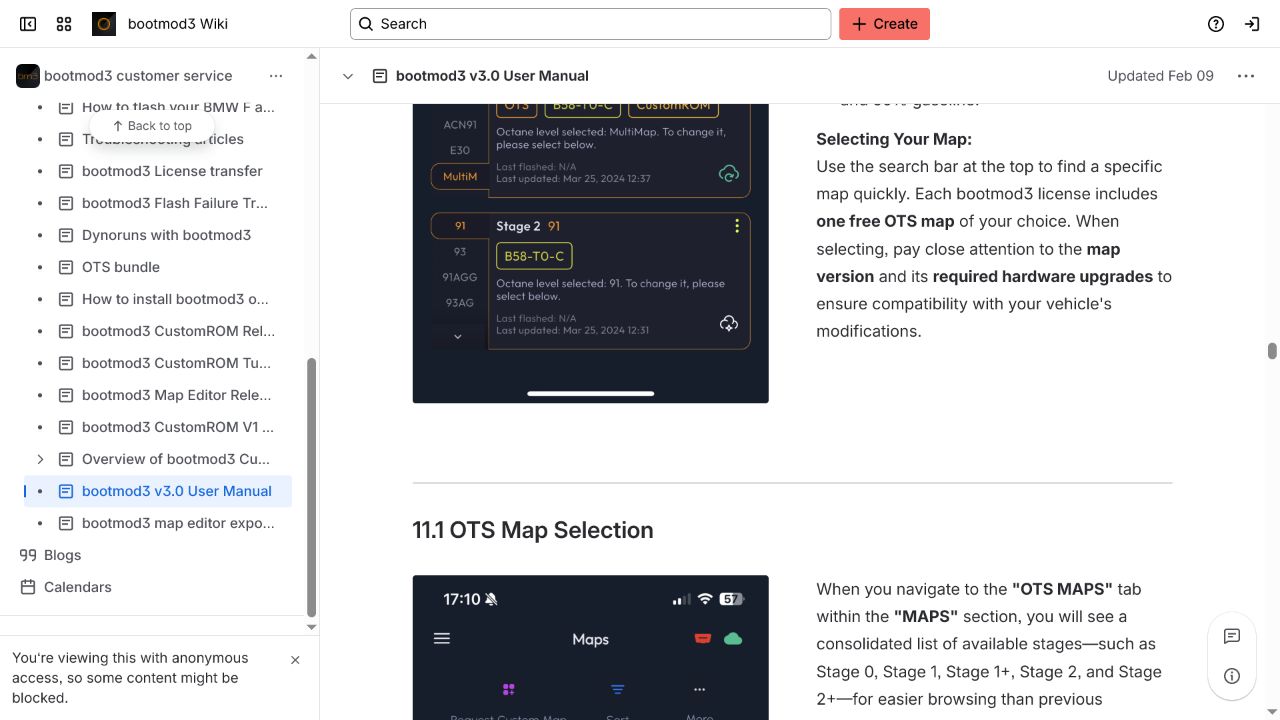
The file is selected for a declared vehicle, stage, hardware and fuel category.
The selection screen has not measured this car's fuel system, temperature response or mechanical condition.
3. What is written to the DME
The app downloads the chosen calibration from BM3's cloud and writes it through the diagnostic connection. BM3 says a downloaded map can subsequently be flashed offline. The flash does not replace the BMW computer; it changes the calibration that the factory DME executes. Depending on the platform and file, relevant control areas can include torque and load targets, boost demand and limiters, ignition timing, lambda and fuelling, fuel-pressure targets, throttle mapping, valve timing and the models that connect requested torque to actual actuator control.
While the engine runs, the DME continues to react to sensor feedback. It compares requested and observed behaviour, applies corrections, uses learned adaptations and invokes strategies configured for temperature, fuel pressure, combustion quality and other conditions. That runtime intelligence is valuable. It does not turn a population-level base target into a vehicle-specific target chosen from pre-flash measurement of this car. Adaptation and custom validation are not synonyms.
Route A
BM3 OTS calibration
The developer establishes targets and validation for a compatible population, packages variants by stage, fuel and hardware, and distributes the same base product to many cars.
ADVANTAGE: speed, consistency, lower development costLIMIT: targets were not chosen from this car's baseline
Route B
Vehicle-specific calibration through BM3
The platform carries a tuner's starting file and revisions. Logs, dyno data and the agreed brief determine what is changed and when development should stop.
ADVANTAGE: evidence from the individual carLIMIT: quality depends entirely on the tuner's process
BM3 also revises its OTS calibrations. A preserved historical version of its official release history records changes to boost or load control, lambda, ignition and torque behaviour. Separate entries for different engines include an S58 revision addressing high-rpm boost taper and wastegate-duty behaviour, and a B58 revision intended to address lower-rpm overboost reported by some users. Those are not evidence of one imaginary universal fault. They demonstrate that even mature OTS products are revised when wider use produces more information.
The app, logging and map switching: useful features, not dyno proof
BM3's interface is a genuine product advantage. Its current official app page presents maps, flashing, datalogging, Live Adjust and diagnostics across phone and computer. Those features can make ownership easier and can help a tuner collect and exchange useful information. The app is the transport, control and presentation layer; it does not establish the quality of every calibration carried through it.
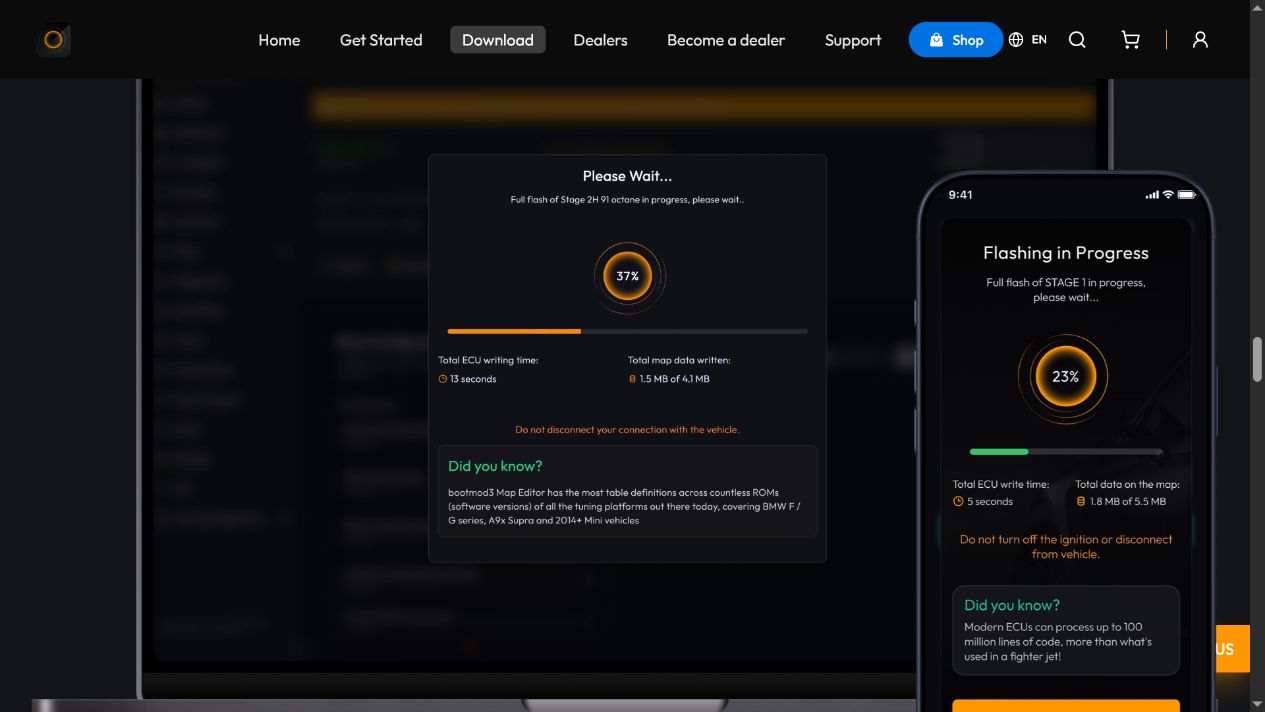
Clear file delivery, flash progress, diagnostics and access to logs can improve the user and tuner workflow.
A slick interface does not prove peak power, area under the curve, hot-run consistency or safety margin.
Records selected DME channels. It becomes evidence only when the correct channels and test conditions are used and the data is interpreted competently.
Useful ownership functions. They do not compare one calibration's performance with another.
Allows a tuner to receive data and issue revisions. This confirms that BM3 itself recognises OTS and custom as different products.
On supported CustomROM software, a single flashed map can contain up to four enabled slots. BM3 says those slots may carry different load, torque, boost, ignition and fuelling calibrations and can be selected through supported steering-wheel controls or Live Adjust without reflashing. That can be genuinely useful for measured fuel variants, reduced torque, track use or another defined operating brief. The slots may also be configured by a custom tuner; the feature is not limited to switching between four canned OTS files.
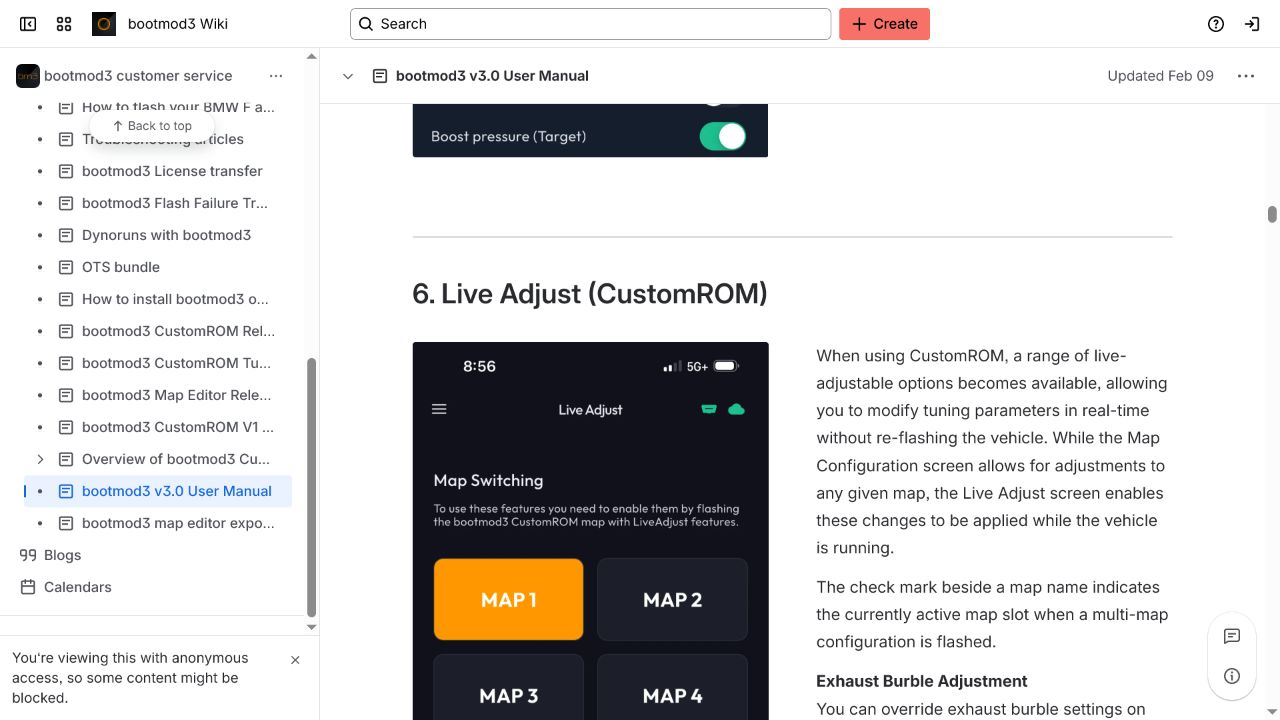
Configured slots can be selected without a full reflash on supported software.
The number of slots says nothing about how well any slot was calibrated.
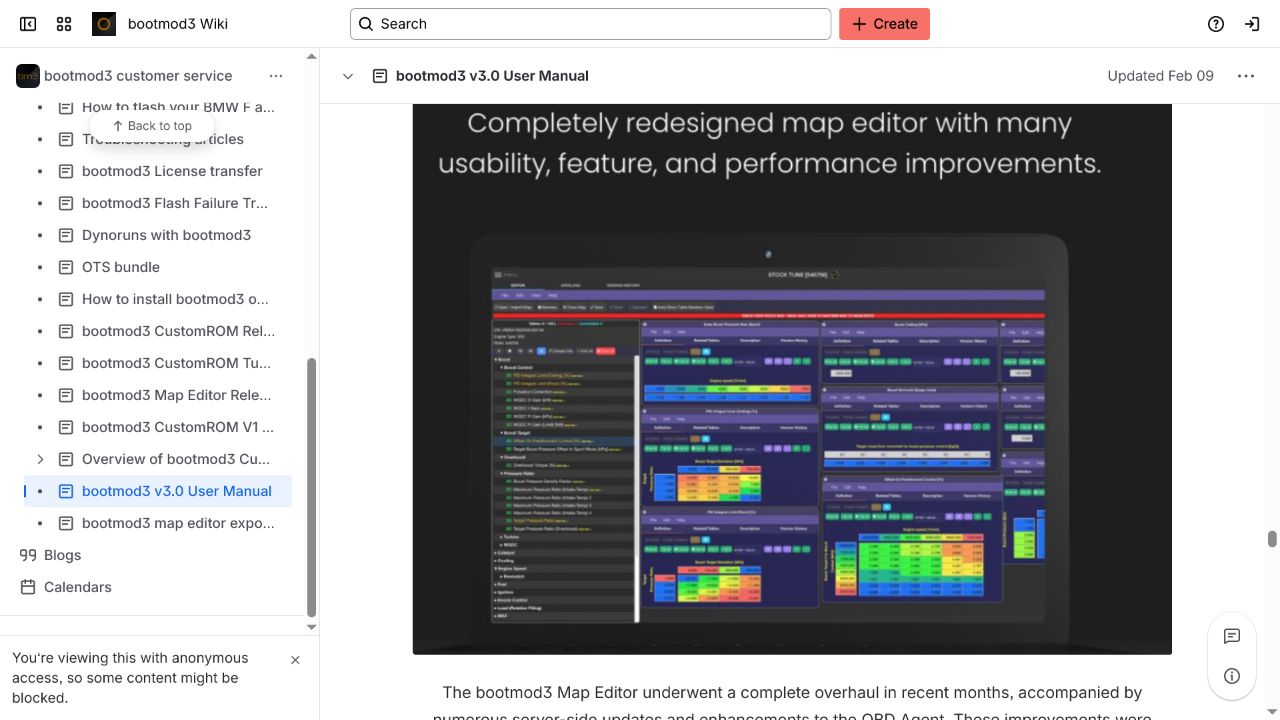
BM3 is also a professional tuning environment, not simply a shop selling downloadable stages.
The platform used to edit or transport a file is separate from the evidence behind that file.
The app is useful. It is not a dyno result. Mobile flashing, cloud delivery, logs, diagnostics, remote tune requests and map switching are real conveniences. None establishes that a particular OTS slot makes more usable power, repeats better when hot or carries more appropriate margin than a completed custom calibration.
Where the “outperforms most custom tunes” claim comes from
The clearest current example we found is an Evo Performance South Africa B58 sales page. Under its Stage 2 advice for South African customers, it says that BM3 Stage 2 OTS maps “outperform or match most custom tunes” when used with 98 RON and E30. E30 means a nominal blend containing about 30% ethanol; its actual ethanol content should be measured rather than assumed.
“Bootmod3 Stage 2 OTS maps outperform or match most custom tunes when used with 98 RON and E30.”
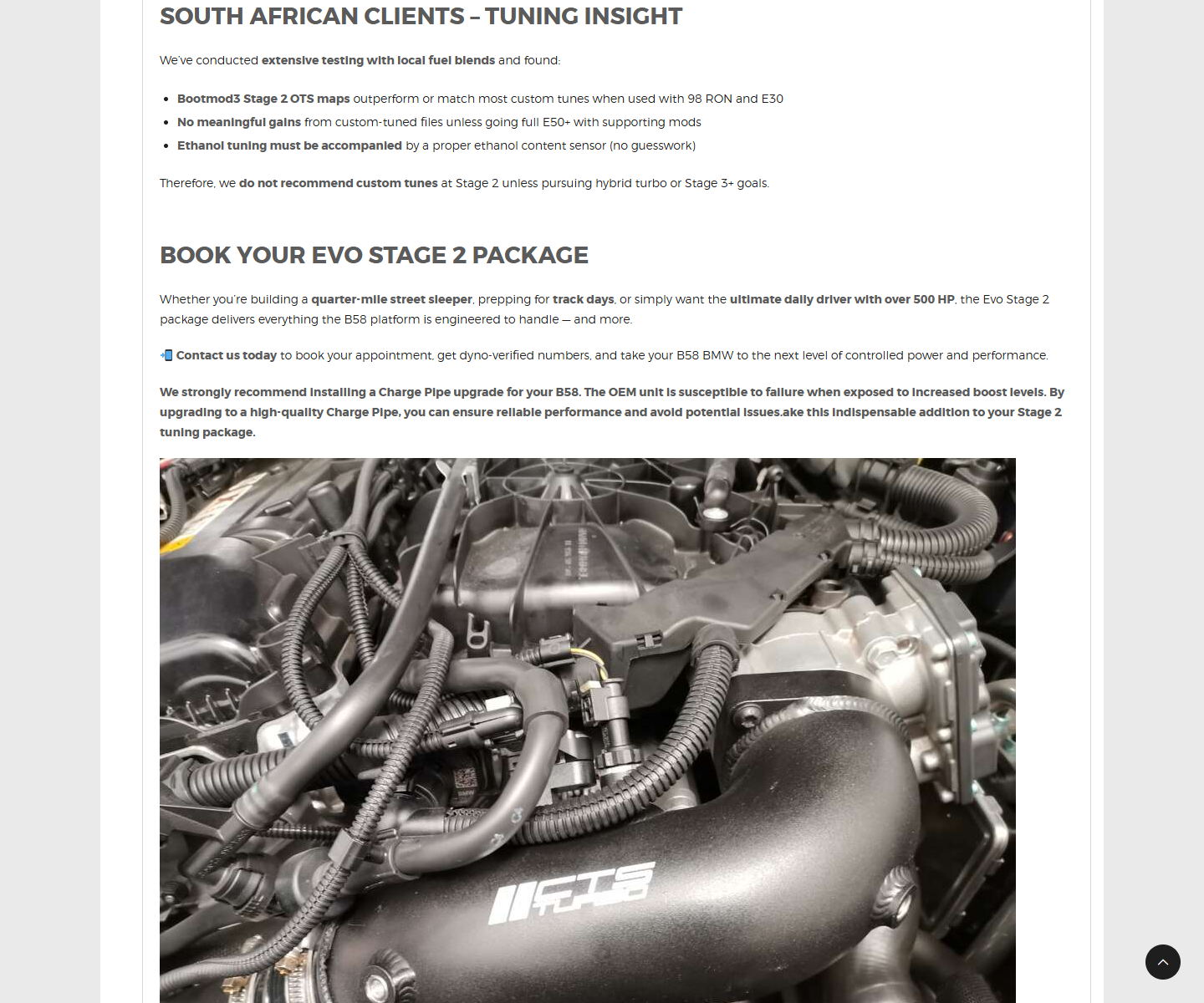
In a defined South African Stage 2 B58 and fuel context, the seller says BM3 OTS outperforms or matches “most” custom tunes.
A representative comparator list, controlled OTS-versus-finished-custom overlays, full logs, repeat runs, sampling method or denominator for “most”.
This is not merely an unrelated forum comment. At the time of review on 13 July 2026, BM3's official authorised-dealer locator listed Evoperformance Pty Ltd at the same Cape Town address. It is therefore fair to say that a business listed by BM3 as an authorised dealer inside the product's sales and installation network was making the claim.
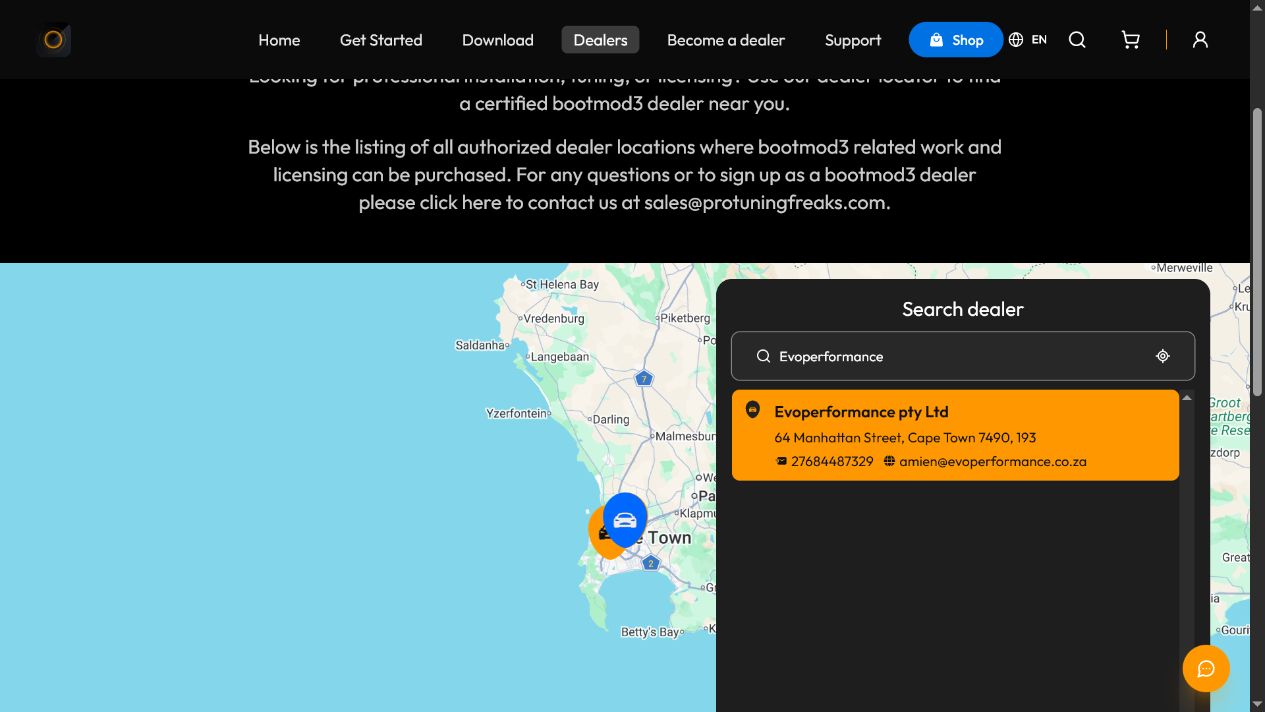
Evoperformance was visibly listed inside BM3's authorised dealer network at the time of research.
A dealer's independent sales wording is not automatically a corporate statement authored by ProTuningFreaks.
It is not, however, accurate to turn that into “BM3 and all its agents say this”. An authorised dealer sells and supports the product, but every sentence on the dealer's independent website is not automatically corporate copy written or endorsed by ProTuningFreaks. We found no equivalent “most custom tunes” or “across the board” statement in the official BM3 product pages reviewed for this article. That attribution line matters because a strong criticism should identify who actually published the words.
The scope is also much narrower than the headline impression. The page discusses first-generation B58 Stage 2 cars, specified downpipe and cooling hardware, South African fuel conditions, and 98 RON or ethanol blends. It does not establish a rule for every BM3-supported engine, every stage, every country, or every form of completed custom tuning.
The same page illustrates why the terminology becomes confused: it labels one Stage 1 offering a “custom-calibrated OTS” tune. Those words pull in opposite directions unless the seller explains exactly what was changed for the individual vehicle, what was logged, how many revisions were completed and how the result was verified. Attaching a customer's details to a reusable base file does not by itself make that file custom.
What a fair OTS-versus-custom comparison would require
The dealer says it has conducted extensive local testing. That may be a sincere summary of its workshop experience. The public page nevertheless does not identify the evidence needed to reproduce the much broader conclusion. It does not show:
The graphs visible on the page show stock-to-stage or fuel-related changes. They are not a disclosed, controlled dataset comparing BM3 OTS with a representative sample of finished custom calibrations. The strongest conclusion the page can publicly support is narrower: on the selected B58 setups and fuels that workshop has encountered, it believes BM3 OTS is often competitive with files presented to it as custom.
That observation is worth discussing. It is not the same as proving a general hierarchy.
“Most” does not mean “every”—but it still needs evidence
It would be wrong to say that a company must test every custom tune on Earth before it may use the word “most”. Statistical claims normally rely on representative samples, not a census. The real problem is that “most” is a population claim and the population, sampling method and denominator have not been disclosed.
One valid counterexample would disprove an absolute statement such as “BM3 always wins” or “BM3 wins across the board”. It would not disprove “most”. Conversely, ten or ninety-nine selected BM3 victories do not establish “most” unless we know how the sample was selected and what counted as a custom tune.
Before the claim has a testable meaning, several questions need answers:
- Does “custom” include a low-cost portal file with a customer's name added?
- Does it include a base revision still waiting for logs and tuner feedback?
- Does it include a completed remote e-tune as well as a tune developed locally?
- Does it include deliberately conservative work for poor fuel, a standard catalyst or a torque-limited gearbox?
- Does it include a circuit calibration that gives away first-pull torque for repeatability when hot?
- Does “outperform” mean wheel horsepower (whp), wheel torque (wtq), usable power through the relevant rev range, acceleration time, consistency, drivability or an agreed operating threshold?
A comparison can be made to produce almost any desired headline if weak competitors, different briefs or a convenient measurement are selected. A high-torque OTS pull may win at 3,500 rpm but lose power at the top of the gear. A custom track calibration may make a smaller first-run peak yet complete repeated acceleration intervals more consistently. Neither is an overall winner until the objective is stated.
The logic must work in both directions
Suppose Llandow Tuning or another workshop publishes a controlled same-car test in which its finished custom calibration makes more power than BM3 OTS. Does that prove every BM3 map is rubbish? No. It proves that one tuner achieved a better result than one OTS variant on one vehicle, with that hardware, fuel, method and brief.
The reverse result has the same limit. If BM3 beats one file described as custom, it beats that file. If it beats a group of finished custom tunes in a credible representative test, it supports a broader conclusion about that defined group. It still does not make the OTS-versus-custom distinction disappear.
This symmetry is essential. A good custom tune can beat a good OTS map without making the OTS map poor. A good OTS map can beat a bad or unfinished custom tune without making every form of vehicle-specific development pointless.
It beat that comparator, on that car, fuel, hardware, day and brief. It does not prove all finished custom calibrations are inferior.
It beat that OTS variant in that controlled pairing. It does not prove every BM3 map is poor.
The products have different advantages. OTS provides immediate availability, consistency and a lower development cost. Completed custom tuning can respond to what the individual vehicle actually does. Neither label alone guarantees competence.
What “custom tuning” actually means
There are at least four very different products hiding behind the same word. Unless the seller identifies the baseline, data, revisions and verification, a comparison against “custom” may quietly mix all four together.
A stock file is read, a supplier selects a reusable template and the result returns without a meaningful vehicle-specific baseline, loaded log, revision or verification.
A known base receives limited configuration or changes, but the service deliberately stops short of a complete measurement-and-revision process.
The file is intended to become vehicle-specific, but a screenshot or pull captures an early revision before the tuner has received data and completed the work.
The car is checked, a baseline is established, loaded data is reviewed, relevant strategies are revised, and the result is retested until the brief or a real limit is reached.
A rolling road is extremely valuable because it provides controlled, repeatable load and immediate comparison. It is not the tuner's physical distance from the car that decides whether a calibration is custom. A completed remote e-tune using valid logs, revisions and verification can be genuine custom work. A car sitting on a dyno while somebody installs an unchanged template is still receiving an OTS file.
This distinction exists inside the BMW tuning industry itself. JordanTuned's published service descriptions, for example, place its no-log OTS+ option below a full custom tune. Bend Calibration explains that broad OTS coverage and vehicle-specific calibration answer different requirements. Both are commercially interested tuners, not independent laboratories, but their product definitions expose the same category problem.
If BM3 beats the first category, the lesson is not that custom tuning has been disproved. The lesson is that a generic product was sold under a more valuable name.
Why a quality OTS map can demolish the thing sold as “custom”
This is the comparison we believe is often hiding behind the headline. A mature BM3 file has central development, repeated distribution, version control and a large user population. Put it against a cheap portal file selected by ECU identity, installed without a proper baseline, and returned without logs or revisions, and BM3 may win comprehensively. That is not surprising. It is an OTS product beating a weaker OTS product that has been given a more expensive label.
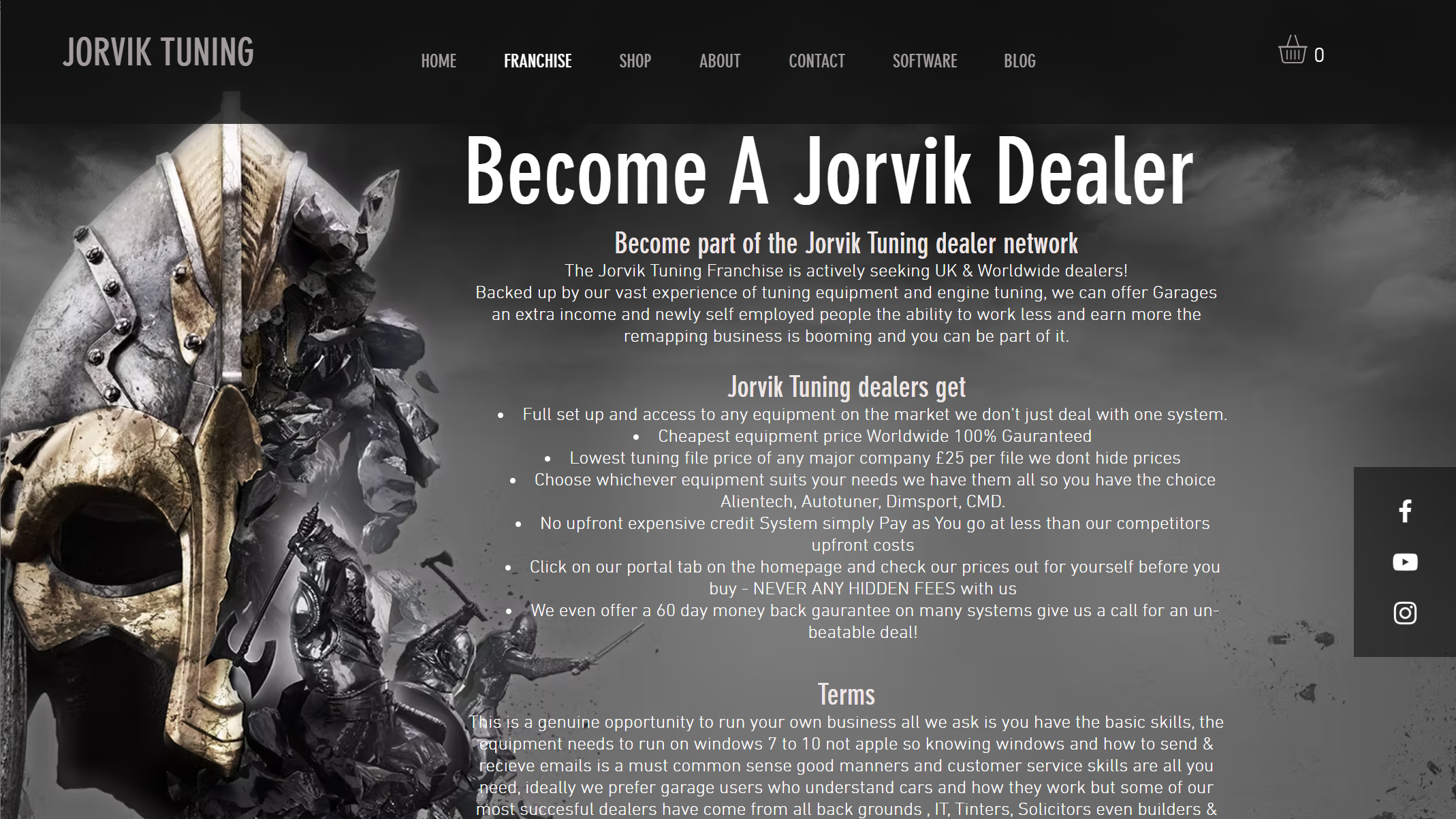
The wholesale value of a supplied file can be tiny compared with the retail price and language attached to the final service.
It does not prove every portal file is poor or every dealer misdescribes it. It shows why the comparator must be defined before calling it custom.
If BM3 beats this category, the lesson is not that custom tuning has been disproved. The lesson is that a reusable file was sold under a word that customers reasonably associate with vehicle-specific measurement and development.
How genuine custom development moves beyond the OTS baseline
A genuine custom calibration is a measured development process, not a sealed retail box. If a starting custom revision is tested next to BM3 OTS and BM3 makes more power, a capable tuner should not simply shrug and declare the weaker graph to be the finished product.
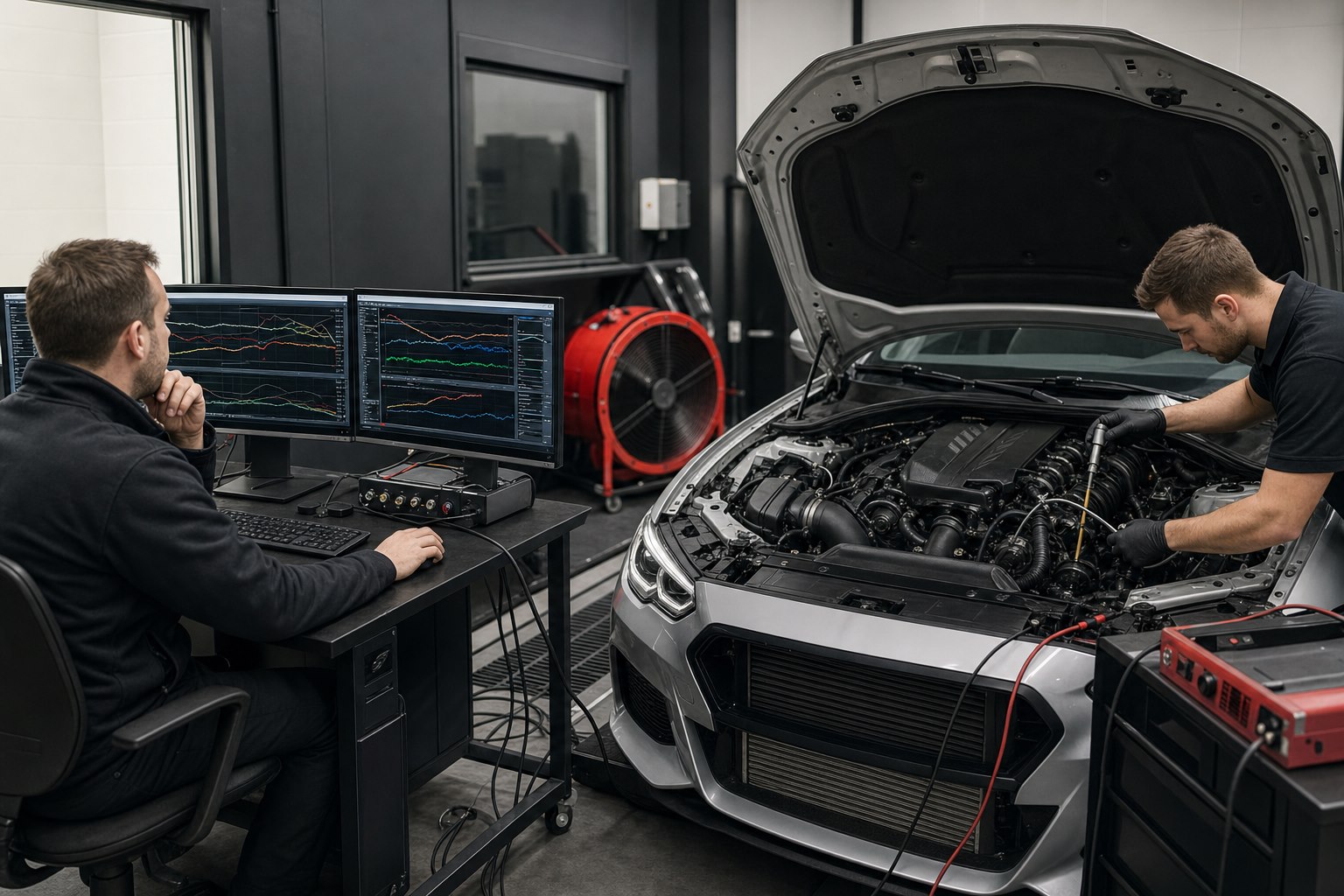
The proper response is: why is it lower, is the difference repeatable, and is there responsible room to improve it?
The tuner studies the entire curve and the supporting data. Requested load may not have been achieved. Wastegate control may need work. The ignition target may be unnecessarily conservative for the measured fuel. Lambda may be richer than the brief requires. A torque monitor may be closing the throttle. Intake temperature may be rising. High-pressure fuel delivery, turbocharger efficiency, exhaust backpressure or the gearbox may already be the true limit. BM3 may simply have a better solution in one operating region and provide a useful benchmark.
Where the evidence identifies usable headroom inside the agreed limits, the relevant strategy can be changed and the test repeated. The result should be checked when hot, not only on the happiest first run. A disciplined loop looks like this:
A completed custom process can test whether a meaningful improvement exists on that vehicle. Sometimes it produces more power. Sometimes it reshapes the torque curve, improves hot-run consistency or removes an intervention. Sometimes it confirms that BM3 OTS is already at the sensible limit for the hardware, fuel and brief. Honest verification is still a valid result.
If BM3 remains ahead after a completed like-for-like process, the tuner should be able to explain why. The OTS file may be operating nearer a threshold than the tuner accepts. The turbo or fuel system may be saturated. The custom brief may prioritise repeated track performance or transmission protection over the largest first-pull number. Those are useful engineering conclusions. An unfinished revision presented as the final custom product is not.
What published tests and forum comparisons really show
An illustrative same-car vendor test supports the distinction
ProTuningFreaks, the company behind BM3, published an older comparison that is especially relevant to this argument. According to its own vendor-authored promotional report, the tests used the same 2007 BMW 335i automatic, same dyno and day, fourth gear, winter tyres, 3-inch catless downpipes, OEM exhaust, BMS dual-cone intakes, an intercooler and US 93 AKI pump fuel. US 93 AKI is broadly comparable to UK 98 RON, although fuel formulations are not made identical by the headline number.
PTF reported that the Cobb Stage 2+ Aggressive OTS map outperformed the tested JB4 configurations and called it the most complete OTS option in that exercise. Using PTF's published terminology, it then reported nearly +30 whp and +80 wtq at peak for its own completed custom calibration over the Cobb OTS result, with a larger mid-range power difference.
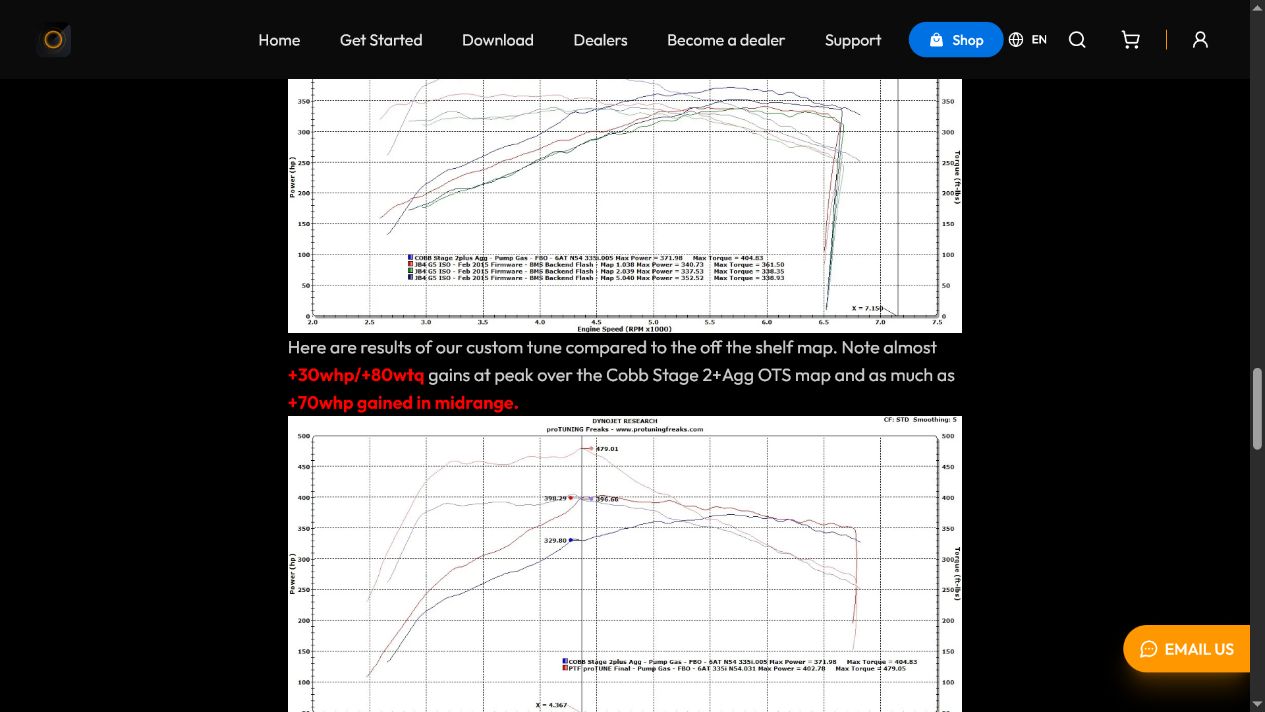
PTF describes the same car, dyno, day, gear and fuel, making this more informative than unrelated screenshots.
The custom-tune vendor designed, interpreted and published its own promotional test; it is not an independent modern B58 trial.
This is useful because it keeps the car, day, dyno, gear and fuel broadly controlled. It is not an independent trial: the custom-tune vendor designed the test, interpreted it and published the sales article. It is also an old N54 comparison, not evidence about every modern B58 or S58 BM3 file. Its legitimate lesson is narrower and important: a strong OTS calibration can beat weaker reusable solutions, while completed custom development can still improve on that strong OTS baseline.
Forum claims cut both ways
Forums are valuable for finding owner experiences and failure modes that polished sales pages omit. They are weak evidence for a universal performance hierarchy because the cars, fuels, dynos, adaptations and tuning states are rarely controlled.
In a 2016 F80 M3 owner report, BM3 Stage 1 came close to a custom result on a car with intakes, standard catalysts and US 93 AKI pump fuel. The owner described roughly four hours and four custom revisions, with uncorrected and unsmoothed dyno figures. According to that account, a 25 psi attempt created more heat without taking peak output beyond roughly 490 whp, so the tuner returned to about 23 psi. That is the owner's report of the session, not independent proof of a universal turbo or thermal limit. It shows why a custom process may correctly stop rather than chase boost that does not create power.
A 2024 X3M discussion points the other way. One owner moved from a BM3 OTS Flex E50 setup to an F80Paul E55 custom tune and described the car as “much faster”. Another contributor repeated a claim of more than 60 whp over BM3 OTS 93 on X3Ms, but that figure was second-hand and was not supported in the thread by a controlled overlay or complete logs. Other drivability praise involved a different prior platform or an unspecified earlier tune, so it is not a clean BM3-versus-custom test.
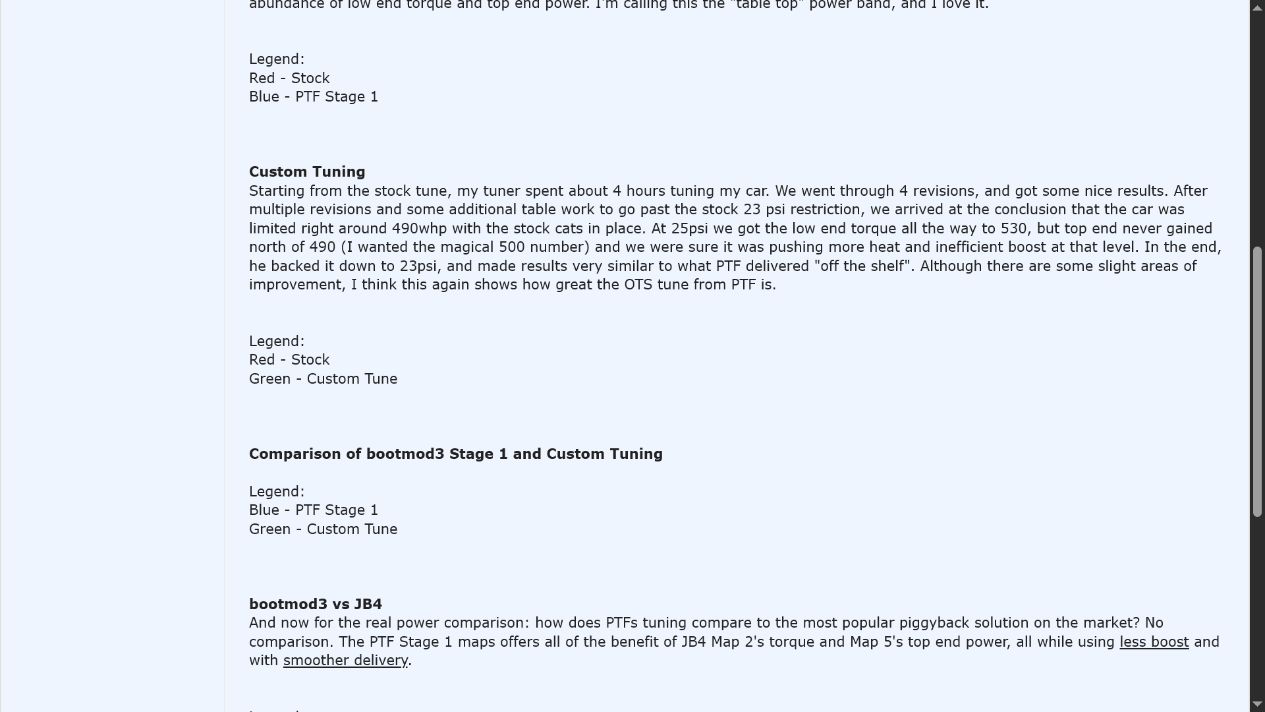
Four revisions ended near the OTS result after extra boost produced heat without more top-end power.
One older car, one hardware set and owner-reported conditions do not define all custom tuning.
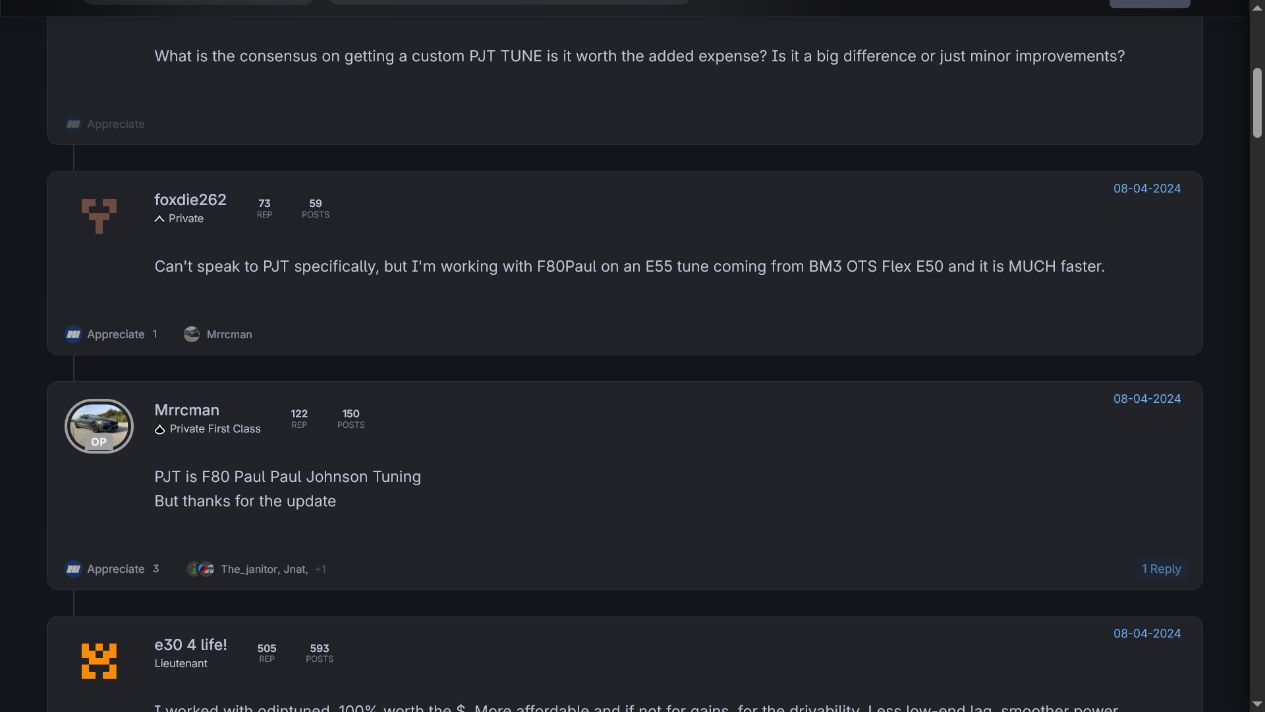
A contributor described the move from BM3 OTS Flex E50 to a custom E55 tune as “MUCH faster”.
No controlled curve overlay, full logs or same-fuel A-B-A protocol accompanies that statement.
In another 2024 F82 M4 Competition thread, an OPF-equipped car—OPF means petrol particulate filter—was reported to move from 462.5 to 486.6 bhp after BM3 Stage 1 93, a 24.1 bhp gain, alongside a much larger torque increase. The J-pipe then detached and air-mass faults appeared. That makes the post an unresolved diagnostic anecdote rather than a clean measure of what BM3 normally produces.
These stories do not cancel one another. They demonstrate the selection problem. A seller can collect only the posts where BM3 wins; a custom tuner can collect only the posts where custom wins. Neither collection supplies the denominator or controls needed for “most”.
A large enthusiast community and strong marketing can amplify genuine owner enthusiasm. Many owners honestly enjoy the sharper response and torque of their tuned car. But post volume and statements about how fast a car feels are not the same as repeatable comparative data. We found no evidence that justifies alleging a coordinated or paid “army” of posters, and the technical argument does not need that allegation.
Why strong OTS products are valuable—and not universal winners
APR and Revo illustrate mature OTS development
Volkswagen Group owners have understood this product category for years. APR and Revo can deliver substantial, refined gains through reusable calibrations. APR publishes outputs by vehicle and fuel grade and warns that results vary with vehicle condition, setup, dyno, environment and fuel. Revo describes validation across dealers, fuels, climates, altitude, road, track and dyno use.
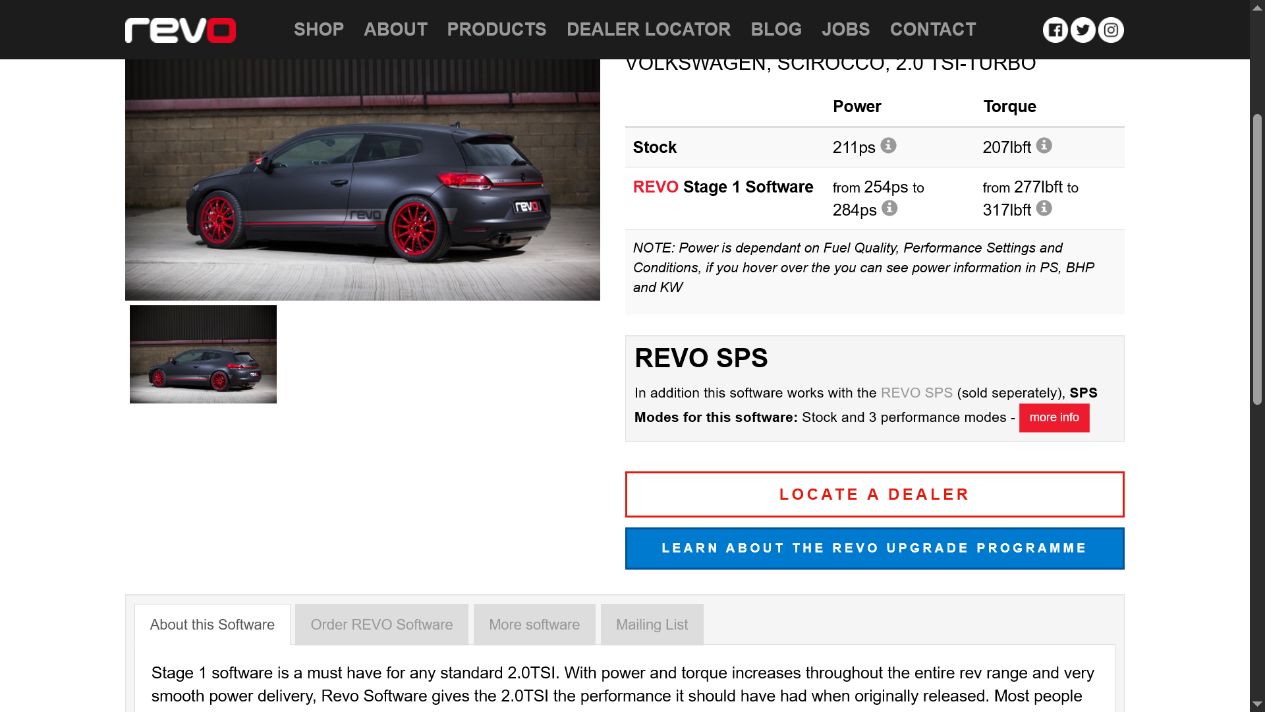
A range and condition caveat recognise that compatible cars do not produce one guaranteed number.
The programme is a reusable product, not a calibration developed from this customer's baseline.
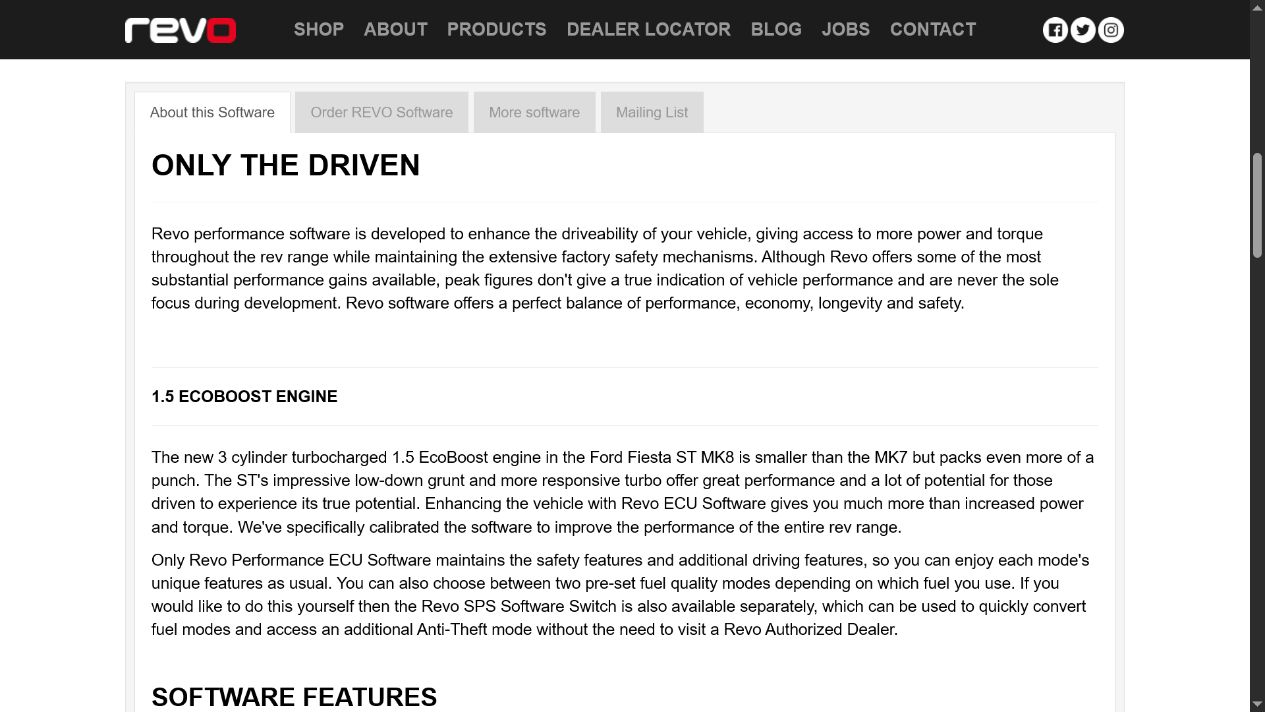
Responsible OTS development is meant to balance output, drivability, longevity and broad operating coverage.
A manufacturer description is not independent evidence that the same targets are best for every example.
Those are manufacturer descriptions, not independent proof that every calibration is best. They nevertheless illustrate what good OTS engineering aims to do: define compatible hardware and fuel, test broadly, preserve robust control and protections, and provide a repeatable product to many cars.
Vehicle specificity is not automatically the same as validation breadth. A mature OTS map may have accumulated more fleet, seasonal, altitude and fuel-variation testing than a rushed one-day custom tune. A poor custom calibration can be less powerful, less refined and less safe than a quality BM3, APR or Revo file.
That balance does not turn OTS into individual calibration. A good APR, Revo or BM3 map may be the ideal value-and-convenience choice for a healthy compatible car. It remains a reusable product with base targets chosen before its developer measured that particular vehicle.
How custom tuners benchmark, develop and know when to stop
A custom tuner does not begin with a blank screen and pretend that no calibration work has existed before. The factory control strategy is the architecture. Previous vehicles, engineering knowledge, known component behaviour, published results and respected products in the market all inform the next decision.
We examine what BM3, APR, Revo and other successful developers achieve because they are meaningful benchmarks. Widely used products arrive on rolling roads. Their power delivery can be measured. Owners describe their response and drivability. Logs show observable requested and actual behaviour. Acceleration data shows how the complete vehicle performs.
The craft lies in asking better questions rather than blindly copying an answer:
- Why does this calibration build torque rapidly in this region?
- Why does requested load or boost taper at this engine speed?
- How does control change as intake temperature rises or fuel quality falls?
- Is the high-load lambda target protecting temperature, or is there measured efficiency available on this car?
- Can the same acceleration be achieved with a smoother torque rise?
- Can top-end power improve without an unnecessary low-rpm hit to the rods, clutch or gearbox?
- Does the turbocharger continue to turn additional pressure into airflow and power?
- Can the vehicle repeat the result after several loaded runs?
A respected OTS result becomes a reference, not an object of worship. The tuner forms a hypothesis, changes an independently developed calibration strategy and keeps the change only if the vehicle's data supports it. Sometimes the market-leading file teaches the tuner something. Sometimes testing exposes an opportunity to do the same job differently or better for that car. That mixture of knowledge, measurement and judgement is why calibration is both engineering and craft.
A successful OTS map raises the minimum standard for everybody. A custom tuner should offer more than a renamed file: vehicle fit, evidence, revisions, an appropriate torque curve, useful repeatability, an agreed operating envelope or a clear explanation that the existing map is already at the sensible limit.
Benchmarking is not a blanket right to copy another tune
There is an important legal and ethical boundary. Good custom tuners can benchmark competing products, study observable behaviour and independently develop their own calibration strategies. That is not the same as decrypting, copying or reselling another company's commercial file.
UK law contains specific, limited provisions concerning software. The Copyright, Designs and Patents Act addresses decompilation in defined interoperability circumstances and observation, study and testing by a lawful user. Licences, technological protection measures, confidential information and the facts of the activity can also matter. The UK Intellectual Property Office guidance makes clear that exceptions are specific; it does not create a blanket right to copy aftermarket software.
The defensible point is straightforward: tuners can learn from measurement and competitive benchmarking where their access, use and testing are lawful, and can independently develop their own calibration strategies. Whether a particular activity is permitted depends on the facts, applicable licences and relevant law. The publishable claim should be independent development from evidence, not an assertion that somebody else's file has no proprietary protection.
The OTS compromise is a continuum, not two crude choices
An OTS developer chooses a position on a continuum. Targets can be conservative or performance-focused. Calibration breadth, runtime control, protection strategies and validation are used to cover the supported population. Mature OTS development can be highly sophisticated; it is not simply a wild target applied blindly.
A modern BMW DME uses feed-forward models, closed-loop feedback, learned adaptations and protection functions. While the engine runs, it observes variables including boost or load, lambda, temperature, fuel pressure and combustion corrections. It can alter control when the actual result differs from the request.
What the OTS developer has not done is choose and verify the base targets from pre-flash measurements of this particular car. Runtime adaptation can manage changing conditions inside the calibrated strategy; it is not the same as completing an individual diagnosis, calibration and validation process.
A broad OTS file must cover production tolerances, wear, regional fuel, temperature, altitude and permitted hardware variations. A developer can retain more general margin, push harder inside a carefully defined compatible envelope, or choose many positions between those extremes. No reusable calibration can be individually maximised for every example while guaranteeing identical mechanical margin on every example.
A completed custom process has an information advantage because it can replace some population assumptions with evidence from the vehicle. Any potential power or safety advantage depends entirely on the quality of that process: diagnosis, competent calibration, retained protection functions, repeatable testing and honest limits. The word “custom” alone does nothing.
“More power” needs a complete definition
A single peak number is one point at one engine speed. A useful comparison should examine the complete system:
Ordinary ECU logs do not directly measure cylinder pressure, pre-ignition, bearing load or every form of component stress. Clean logs are necessary evidence, not proof that every mechanical margin has been measured.
A custom tune that reduces an excessive low-rpm torque spike, holds more power later in the gear and repeats when hot may be the quicker and better result even if the OTS sheet shows the larger peak torque. Conversely, if BM3 already reaches the sensible hardware and fuel limit cleanly, an honest custom result may show the same peak, a different delivery or no reason to replace the OTS file.
The idea that a custom tuner can always find another half horsepower is not a defensible scientific rule. Half a horsepower can be smaller than normal dyno and run-to-run variation. Removing a necessary margin merely to win by one pixel is not better tuning. Only an improvement larger than measurement uncertainty, repeatable under comparable conditions and achieved within the agreed thresholds should be claimed as a win.
Power, safety and the cost of pushing too far
Engine calibration is a constrained optimisation problem. An SAE paper on turbocharged direct-injection calibration describes optimisation involving air-fuel ratio, spark, boost and cam phasing while respecting knock and exhaust-temperature constraints. Real production control adds further interacting torque, emissions, component and drivability requirements.
Any calibration—OTS or custom—can damage an engine or drivetrain if hardware limits and protections are misunderstood or deliberately exceeded. BM3's own terms warn that incorrectly changed parameters can damage the engine or vehicle and advise monitoring. That is a general tuning and software warning, not evidence that BM3 OTS maps routinely damage engines.
The risk logic nevertheless matters. If a reusable OTS file is pushed extremely hard so it can headline the biggest number across a varied population, weaker cars, poorer fuel or hotter conditions may have less room. If it retains broad margin, some individual cars may have responsible headroom that a competent custom tuner can test. A good OTS developer manages that compromise with validation and protections; a good custom tuner manages it with vehicle-specific evidence.
A poor custom tuner can push too far as easily as an aggressive OTS developer. A laptop, dyno booking and invoice do not confer skill. Any potential custom-tuning safety advantage depends on the actual process and on the tuner's willingness to stop when the data says stop.
More is not automatically better. If a claimed gain is smaller than normal run-to-run uncertainty, disappears when hot, requires removing an agreed safety threshold or produces pressure without airflow and power, it is not a meaningful custom-tuning victory.
What genuine custom tuning means at Llandow Tuning
At Llandow Tuning in South Wales, custom does not mean renaming a downloaded generic file. The exact process depends on the vehicle, control system, modifications and agreed job, but genuine vehicle-specific work is built around the following principles where appropriate:
That work may produce more peak power than BM3 OTS. It may improve output later in the rev range, reshape torque, resolve an intervention or improve consistency. It may identify a boost leak, tired pump, cooling problem or gearbox limit that should be addressed first. It may confirm that the existing quality OTS map is already doing the sensible job for the available hardware and fuel.
All of those outcomes are more honest than promising a number before measuring the car. Our detailed guide to OTS maps versus genuine custom remapping explains the wider process and the questions customers should ask before buying any tune.
The verdict
BM3 is a capable tuning platform and its best OTS maps can be excellent OTS products. They can outperform low-cost generic files, unfinished revisions and some completed but weaker calibrations sold as custom. They may also be the best-value answer for an owner who wants supported gains, convenient flashing and no vehicle-specific development bill.
An authorised BM3 dealer is publicly claiming that its Stage 2 B58 OTS maps outperform or match most custom tunes in specified South African fuel scenarios. We have preserved the wording above. The page does not publish the representative comparison group, controlled methodology or complete dataset required to establish “most”, and we did not find that sweeping wording on the official BM3 pages reviewed.
The comparison that matters is not BM3 against anything somebody has chosen to call custom. It is a quality OTS calibration against a completed, like-for-like, vehicle-specific process, tested to the same brief on the same car, hardware, measured fuel and method.
A persuasive public comparison controls temperatures, run order and adaptation; repeats the tests; shows complete curves and logs; states measurement uncertainty; and explains the limit. It does not substitute app screenshots, forum popularity or a winning peak number for evidence.
A good OTS map fits a supported vehicle category. A genuine custom tune is developed to fit the car in front of the tuner.
If you want a vehicle-specific assessment rather than a renamed generic file, speak to Llandow Tuning in South Wales. We can inspect the car, establish the brief and explain whether custom calibration is likely to offer more performance, a better torque shape, improved repeatability—or simply confirmation that the existing map is already doing its job properly.
Research sources
- Evo Performance: B58 Stage 1 and Stage 2 package claims (reviewed 13 July 2026)
- bootmod3 official authorised-dealer locator
- bootmod3 v3.1.1 user manual: connection, unlocking, maps, logging, Live Adjust and map editor
- bootmod3 official app and feature page
- bootmod3 official FAQ: OTS maps, custom tuning, app functions and datalogging
- bootmod3 official B58 release and published OTS gains
- bootmod3 historical OTS map release-history version
- bootmod3 CustomROM and map-switching documentation
- ProTuningFreaks: older same-car OTS and custom vendor comparison
- BimmerPost: 2016 BM3 Stage 1 and custom F80 owner comparison
- XBimmers: 2024 BM3 OTS and custom X3M owner discussion
- BimmerPost: 2024 OPF F82 BM3 Stage 1 owner report
- JordanTuned: OTS+, no-log and custom product definitions
- Bend Calibration: OTS and custom calibration distinctions
- APR: published staged ECU output and test-condition caveats
- Revo: manufacturer description of OTS development and validation
- Jorvik Tuning: dealer and per-file pricing page (captured 10 July 2026)
- SAE 2010-01-0780: constrained optimisation of turbocharged GDI calibration
- bootmod3 official terms: parameter changes, monitoring and mechanical risk
- Copyright, Designs and Patents Act 1988, section 50B
- Copyright, Designs and Patents Act 1988, section 50BA
- UK Intellectual Property Office: copyright exceptions guidance